Australian households generate solar they can't use when they need it most.
We're building the thermal infrastructure to fix that, designed here, made here, for conditions we understand.
Australia Leads the World in Solar. The Timing Is the Problem.
Australia has built the highest rooftop solar penetration on earth: more than 4 million systems, roughly one in three homes.
But solar is abundant exactly when homes need it least, the middle of the day, while the biggest loads arrive after the sun goes: cold mornings, evening showers, winter nights. The grid is flooded with cheap solar by day, then strained when it disappears and wholesale prices spike.
That timing gap is quietly punishing solar households. The value of exporting has collapsed, while the cost of importing at night keeps climbing:
| Year | Solar export price (per kWh) | Grid import price (per kWh) |
|---|---|---|
| 2014 | $0.50 | $0.20 |
| 2020 | $0.10 | $0.25 |
| 2025 | −$0.01 | $0.35 |
Export rates have fallen to nothing, and the new "sun tax" now charges for exporting at the wrong time. So households pay more to import energy at night than they earn exporting it by day, and the grid leans on coal and gas to cover the evening peak. See AEMO's live price data
Why Batteries Fall Short for Homes
Home batteries get marketed as the answer to all of this. For a household's biggest loads, they're the wrong tool.
Expensive
$8,000 to $15,000 installed, for uncertain returns.
Short-lived
Lithium degrades within about 10 years, losing capacity every cycle. You're rebuying infrastructure on a decade timer.
Risk and complexity
Fire restrictions, inverters, permits.
Imported
Battery manufacturing is heavily concentrated offshore. Australia's energy resilience shouldn't depend on overseas, coal-powered supply chains.
A battery stores electricity. But most of what a home actually controls, heating, cooling, hot water, is heat. Using expensive electrochemical storage to later recreate heat is overkill when the load was thermal to begin with.
The Real Load Is Thermal
Here's the part the battery story misses: 60 to 70% of the energy a home actually controls is thermal: heating, cooling, and hot water. These loads are large, predictable, and flexible, but only if the home can store heat.
Storing energy as heat in mass is structurally cheaper than storing it as electrons in chemistry. That cost gap is physics, and it doesn't close as battery prices fall. It's the whole reason thermal storage makes sense where batteries don't: you're matching the cheapest form of storage to the largest, most shiftable load in the house.
The macro signals all point the same way. AEMO projects the grid will need roughly three batteries' worth of storage per household by 2050; retailers are now rolling out free electricity windows (e.g. 11am to 2pm) to soak up the midday solar surplus, the exact daily window a thermal battery is built to charge in. The storage is needed, and the price signal to shift load already exists.
Our Mission: Comfort Without Compromise
We engineer Australian thermal systems that free homes from rising bills and turn distributed solar from a grid burden into a grid backbone.
Lower energy bills
Shift usage to off-peak and capture your dawn solar instead of buying expensive peak power.
Maximise solar ROI
Use your own solar for heating, cooling, and hot water instead of exporting it for almost nothing.
Support the grid
Cut peak demand and help stabilise the system, one home at a time.
Sustainable comfort
Renewable heat and cooling year-round, with no lithium and no charge cycles to wear out.
Built for Our Extremes. Made Here.
The hard part for hydronic heat pumps in Australia isn't summer, it's the shoulder seasons and cold snaps that push systems to their limits. Thermal Dawn is designed for Victorian cold snaps, alpine-fringe conditions, and humidity alike. Because the system pre-charges during the day when conditions and efficiency are best, it doesn't have to run hard through the coldest hours.
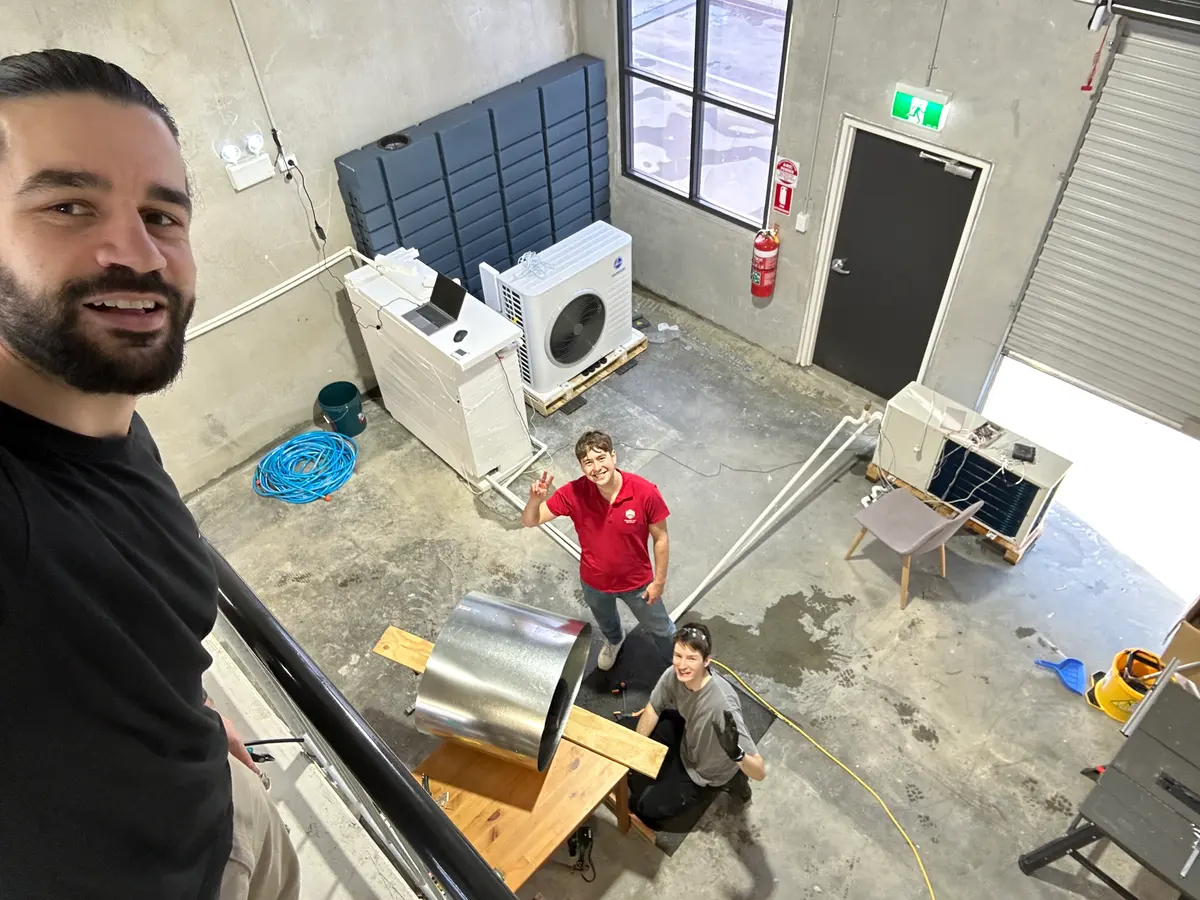
And it's genuinely ours. The thermal store is built from Australian materials and assembled at our own production facility in Hornsby, New South Wales: built to last decades, not a 10-year replacement cycle. Because Thermal Dawn installs through plumbers and HVAC trades rather than electricians, every system is an Australian-owned, Australian-controlled grid asset: not imported storage. As energy sovereignty becomes a board-level concern worldwide (the EU moved in April 2026 to block public funding for foreign-made solar inverters, calling the dependence one of the "most pressing threats" to critical infrastructure), building the storage layer here matters more, not less.
Proof, not promises
A Home in Melbourne
Mike and Kay in Hawthorn had solar on the roof and a gas hydronic system, and the same bad trade-off as thousands of others: solar by day, heating demand at night, and a conventional heat-pump path quoted well over $20,000. We gave them a third option.
Their system has been live since May 2026. Gas boiler gone, gas meter off the house, heating now running on stored solar. Running totals from their own app: $1,439 saved, 29,040 MJ of gas avoided, 1,489 kg of CO₂ avoided.
"We've been looking for 5 years for a hydronic heat pump, but we didn't want to pay $25,000. We finally did it."
Mike & Kay, Hawthorn
What This Looks Like at Scale
One home cuts a bill. A million homes reshape the grid.
And the grid-scale upside is real. Modelling the same idea across a high-solar state like Queensland: if every solar home also had a Thermal Dawn system, peak daily energy swings could drop from 4GW to 2GW: enough to retire around 2GW of coal. (Modelled/illustrative.)
Why We're Building This
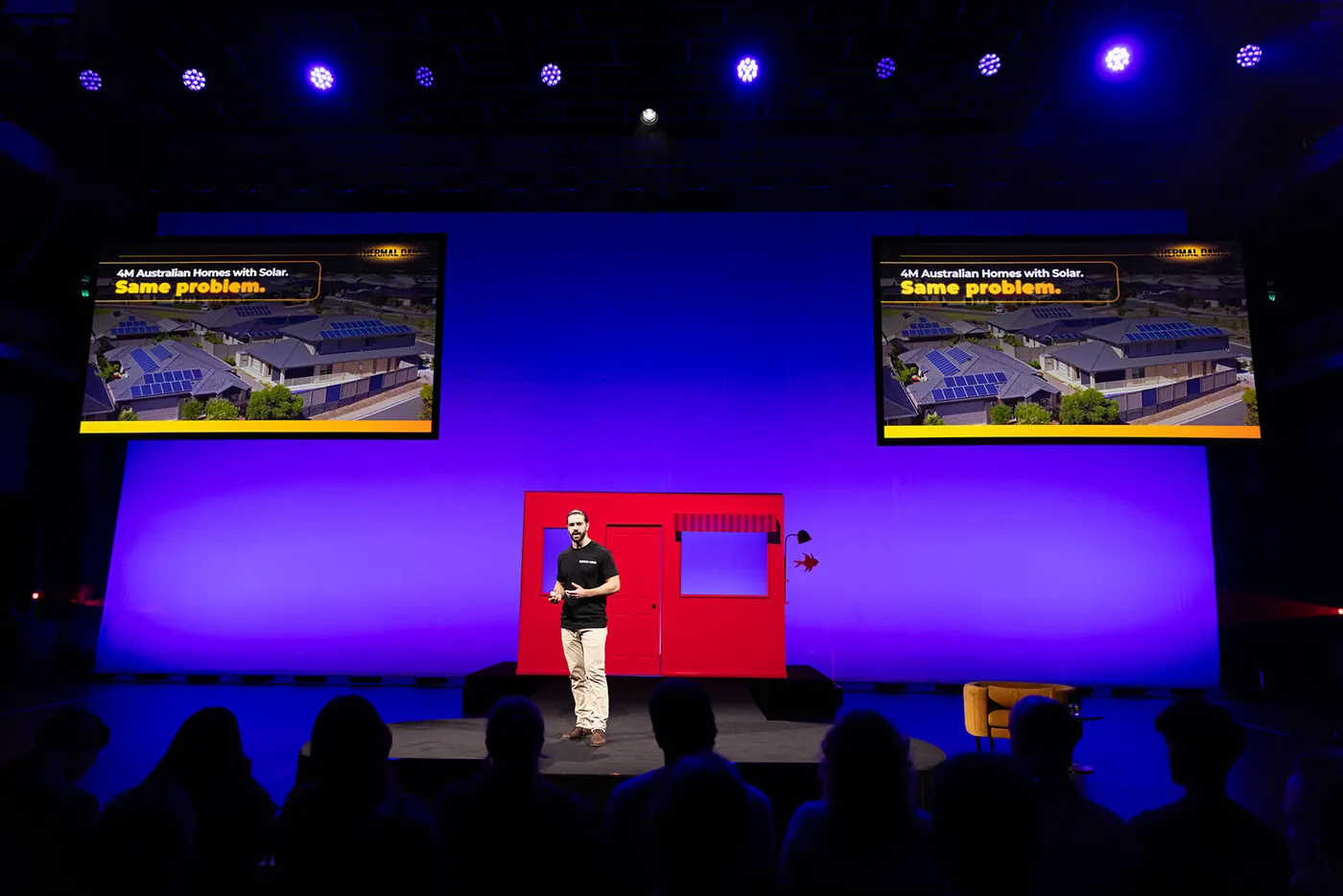
Nick Zeniou, Thermal Dawn. Startmate Summer '26 Demo Day.
Thermal Dawn was selected for Startmate's 2026 cohort. Above is our founder making the case, to a room of investors and operators, for why Australian homes need thermal storage, not another imported battery.
Founder
Thermal Dawn was founded by Nick Zeniou, an experienced product and engineering leader. As an engineer in HVAC and large-scale energy generation, Nick saw a better path: thermal storage engineered for Australian conditions, from Australian materials. From power stations to plant rooms he learned what keeps critical systems reliable, durability, serviceability, safety, and from leading consumer software teams, how to turn complex systems into simple experiences people actually use. So he built a thermal battery designed for Australian homes: durable, serviceable, and made here.